Ron’s Financial Lab · Corporate Governance · Family Business · Based on Yeoh & Hooy (2022), Asia Pacific Journal of Management
Do you ever check a CEO’s age before buying a stock?
A study in the Asia Pacific Journal of Management suggests that CEO age can be a useful signal. It may tell us how willing a company is to invest and take risks.
The study by Siew-Boey Yeoh and Chee-Wooi Hooy from Universiti Sains Malaysia examined 6,169 firm-year observations of Bursa Malaysia Main Board companies from 2009 to 2017.
The main question was simple:
Does CEO age affect company risk-taking, and does it make a difference whether the CEO is a family member or a hired professional?
The Simple Version First: All CEOs Follow an Inverted U
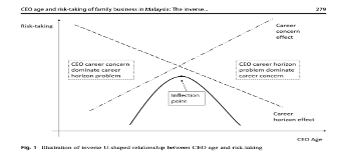
For the general population of CEOs — family or not — the relationship between age and risk-taking follows an inverted U shape.
Young CEOs take more risks. They are early in their careers, their reputations are not yet established, and the best way to signal ability to the market is to pursue bold strategies — higher R&D spending, bigger capital investments, more leverage. The researchers call this the career concern effect.
As CEOs get older and approach retirement, the opposite happens. Their time horizon shortens. A risky project that might only pay off in five years is less attractive to someone who will not be around to see it through. They become more conservative — protecting their legacy, safeguarding their pensions, and avoiding decisions that could damage their reputations in the final years of their tenures. This is the career horizon effect.
The inflexion point — where risk-taking peaks and then declines — occurs around age 44 to 45 across all three risk measures the researchers used: R&D expenditure, capital expenditure, and financial leverage.
The Family CEO Twist: An Inverse S-Curve
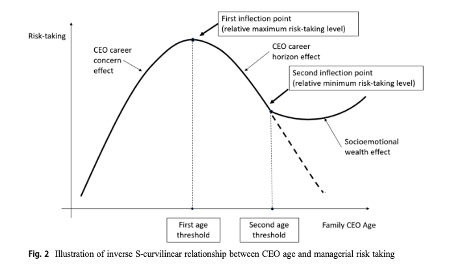
Here is where it gets more interesting. For family CEOs, the simple inverted U does not hold. The relationship becomes an inverse S-curve with two turning points instead of one.
The pattern goes like this.
Young family CEOs behave much like any young CEO — ambitious, career-conscious, willing to take risk to prove themselves and grow the business.
In middle age, they pull back. Around their late 30s to early 40s, risk-taking dips. They have a shorter horizon for any individual project to pay off, and they are conscious that a failed risky bet could hurt the family firm they are entrusted with.
But then something unusual happens in old age. As family CEOs approach retirement — in their 60s and beyond — risk-taking climbs again. This is the opposite of what happens with professional CEOs, who become steadily more conservative as retirement nears.
The researchers explain this through a concept called socioemotional wealth. Family CEOs are not just managing a company — they are stewarding a family legacy. As retirement approaches, their focus shifts from running the business to securing its future for the next generation. That motivates them to make bold, long-term investments that a professional CEO with no family skin in the game would not attempt.
The second inflexion point — where risk-taking rises again — occurs between ages 61 and 73, depending on the type of investment measured. For R&D, the most long-term and uncertain type of investment, the reversal happens latest, around age 73. This makes intuitive sense: only a founder truly committed to the business they built would pour money into long-horizon R&D in their 70s.
Real Malaysian Examples the Researchers Cite.
“These are not lucky exceptions. The researchers tracked around 686 companies listed on Bursa Malaysia’s main board, checking each one every year from 2009 to 2017. That repeated tracking across nine years produced 6,169 data points in total — one for each company, each year. Across that entire dataset, the pattern holds consistently: family CEOs near retirement take more risk, not less.”
What the Data Actually Shows
CEO Profile and Company Spending: What the Numbers Tell Us
| Data Point | What the Study Found | Simple Meaning for Investors |
| Average CEO age | 55 years old | Most CEOs in the sample were experienced and middle-aged. |
| Oldest CEO | 96 years old | Some companies are still led by very senior leaders, possibly founders or long-time family leaders. |
| Youngest CEO | 23 years old | A few companies had very young CEOs, likely linked to family succession or founder-family ownership. |
| Average CEO tenure | 11 years | Many CEOs had been in charge for a long period, which suggests leadership stability. |
| Longest CEO tenure | 46 years | This is almost certainly a founder or a very long-serving family leader. |
| Family CEOs | 68% of the sample | Most companies in the sample were led by CEOs with family links. This shows how common family control is in Bursa Malaysia companies. |
| Average R&D spending | 0.7% of total assets | Malaysian listed companies in the sample spent very little on research and development. |
| Average capital expenditure | 3.5% of total assets | Companies spent more on physical assets and business expansion than on innovation or research. |
Summary of CEO Age Turning Points and Risk-Taking
| Risk-taking measure | Professional CEO peak age | Family CEO first peak | Family CEO lowest point | Interpretation |
| R&D investment | 44 years | 36 years | 73 years | Professional CEOs increase R&D risk-taking until around 44, then reduce it. Family CEOs peak young, reduce risk-taking later, then increase again near older age. |
| Capital expenditure | 44–45 years | 35 years | 51 years | Capex risk-taking peaks around the mid-40s for professional CEOs. For family CEOs, the decline happens earlier and bottoms out around 51. |
| Financial leverage | 44–45 years | 38 years | 61 years | Professional CEOs take the most leverage risk around the mid-40s. Family CEOs reach their first peak around 38, then the lowest leverage risk appears around 61. |
Honest Limitations of the Study
The study is useful, but its limits are clear. The data covers 2009–2017, so later governance reforms, succession changes, and market conditions may have shifted the patterns. It measures risk-taking through R&D, capex, and leverage, but not acquisitions, market expansion, or ESG decisions. The sample is limited to Bursa Malaysia Main Market firms, excluding financial firms, REITs, closed-end funds, ACE Market, and LEAP Market companies. Finally, not every older family CEO is driven by legacy; some may be entrenched, facing succession issues, or taking risks for reasons outside the model.
Academic Reference
Yeoh, S. B., & Hooy, C. W. (2022). CEO age and risk-taking of family business in Malaysia: The inverse S-curve relationship. Asia Pacific Journal of Management, 39, 273–293. https://doi.org/10.1007/s10490-020-09725-x
This content is for educational purposes only and does not constitute financial or investment advice. Always conduct your own research or consult a licensed financial adviser before making investment decisions.